Questioning how we do research: influence, integrity, excellence
Research in a changing world also has to examine its own methods. The same approach applies: compare with an explicit reference, look at what a single number hides, and state the limits.
Who did what. The science-wide map of institutions: John P. A. Ioannidis (Meta-Research Innovation Center at Stanford, Stanford University), Jeroen Baas and Roy Boverhof (Elsevier, Amsterdam), with Cyril Voyant (Mines Paris – PSL, Centre O.I.E.). The Influence Index: Cyril Voyant, Jeroen Baas, Roy Boverhof, Paolo Stringari, Marion Marchand-Lasserre and John P. A. Ioannidis. The excellence framework: Cyril Voyant, Rodrigo Amaro e Silva, Nicolas Fichaux, Lionel Menard, Sylvain Cros and Rodanthi-Elisavet Mamouri.
In brief
- Counting highly cited researchers mixes up size and concentration. A share compared with a neutral 2 % baseline, on a doubling scale, says how concentrated influence is, independently of the size of an institution.
- Impact alone is not enough: a science-wide map of institutions by J. P. A. Ioannidis (Stanford), J. Baas and R. Boverhof (Elsevier) and C. Voyant, in Royal Society Open Science (2026), puts it next to research-integrity proxies: retractions, extreme self-citation, publication in discontinued journals.
- Publishing is no longer enough either: in a saturated system, research must be found, trusted and reused. The RTVACOS framework treats excellence as a multiplicative system in which one weak foundation collapses the whole.
The finding
The tools we use to judge research deserve the same scrutiny as the models we use to forecast the sun or compute a dose. A volume indicator rewards size; a single score hides integrity problems; a good paper nobody finds has no impact. Each of these questions has the same answer as elsewhere in this work: an explicit reference, several complementary measures, and stated limits.
The question
How should an institution, a funder or a researcher read research performance at a time when output has grown fourfold since 2004 and AI writing tools accelerate it further? Which indicators measure what we think they measure?
The theory, in plain words
Influence, independently of size. With X highly cited authors among N eligible authors of an institution, the share is p = X/N. It is compared with the share expected by construction of the Top 2 % lists, p₀ = 0.02:
I = log₂(p / p₀)
I = 0 means the baseline, I = +1 twice the baseline, I = −1 half of it. The scale is symmetric and does not depend on the size of the institution or on the performance of others. The idea is the same as comparing a forecast with persistence: a score means something only against a stated reference.
Impact and integrity, side by side. The science-wide map published in Royal Society Open Science (2026) adds three proxies of possible integrity problems: authorships in papers retracted for reasons other than publisher errors, and the shares of top-cited authors with extreme self-citation or many publications in titles discontinued by Scopus.
Excellence as a system. RTVACOS treats excellence as E ∝ (R × T × V × A) × (1 + C + O + S): four foundations (Rigour, Transparency, Visibility, Adoption) that multiply each other, so that a zero in one collapses the whole, and three amplifiers (Collaboration, Outreach, Societal relevance) that scale a solid base but cannot replace it.
The example in figures
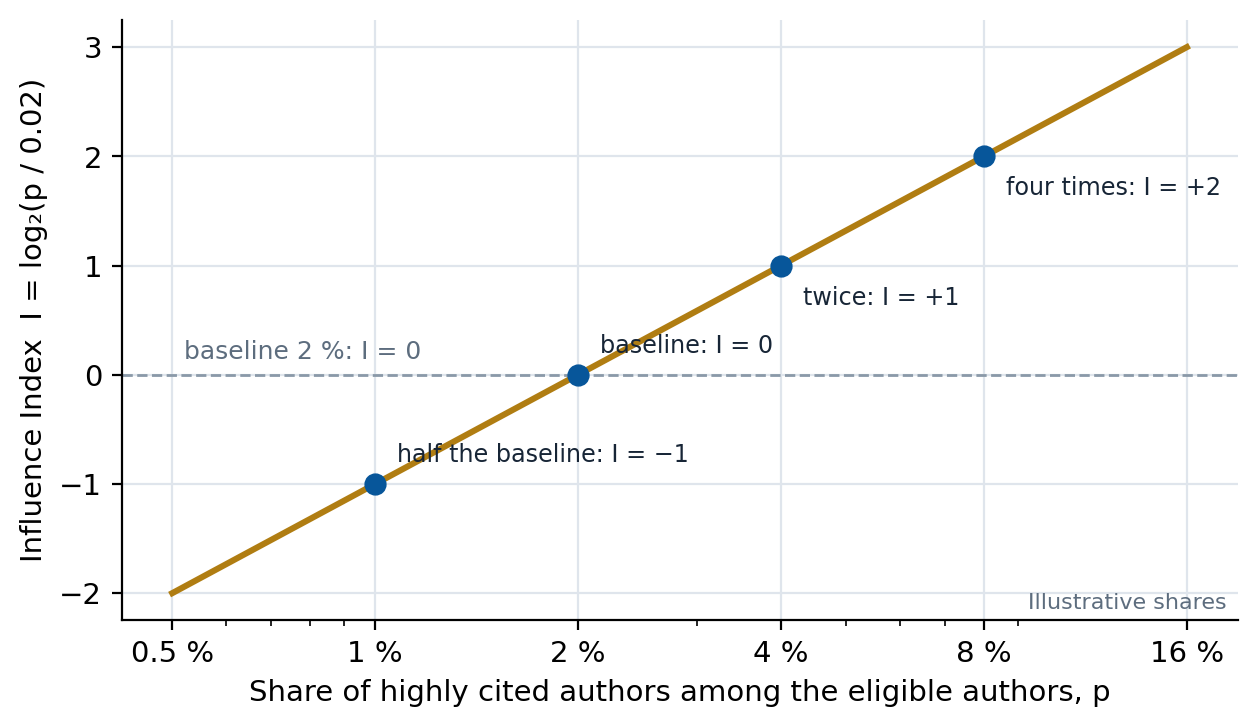
An institution where 4 % of the eligible authors are in the Top 2 % lists has I = +1: twice the baseline. One at 1 % has I = −1. These shares are illustrative.
What it brings, and its limits
- Brings: indicators that separate size from concentration; impact read together with integrity; open datasets that let anyone redo the analysis; a reflection framework for researchers and institutions on rigour, transparency, visibility and adoption.
- Limits: citation-based indicators are proxies, not judgments of individuals or of quality; integrity proxies flag patterns to examine, not misconduct. RTVACOS is a heuristic for reflection, not a scoring instrument, and claims no empirical validation. The application of the Influence Index to French universities is a manuscript in submission (Scientometrics); its results will be reported once published.
Go further
- Article: J. P. A. Ioannidis, J. Baas, R. Boverhof, C. Voyant, Science-wide mapping of institutions based on affiliated authors' impact and research integrity proxies, Royal Society Open Science 13, 260870 (2026), doi:10.1098/rsos.260870 (open access) · preprint doi:10.64898/2025.12.16.694665 · data doi:10.17632/jn5j7gjpzj.1
- Influence Index, code and processed data: github.com/cyrilvoyant/influence-index-bibliometrics · doi:10.5281/zenodo.19706465 · manuscript A Log-Based Influence Index for Evaluating Research Institutions (C. Voyant, J. Baas, R. Boverhof, P. Stringari, M. Marchand-Lasserre, J. P. A. Ioannidis), in submission
- Excellence framework (RTVACOS): C. Voyant, R. Amaro e Silva, N. Fichaux, L. Menard, S. Cros, R.-E. Mamouri, Beyond Publish and Pray: Engineering Research Excellence, SSRN preprint (2026), doi:10.2139/ssrn.6877118 · the talk, summary and references
- In French: op-ed in News Tank Éducation & Recherche (3 March 2026) and the post Excellence scientifique à l'ère de l'IA : du SEO au GEO on this site
- The approach behind this work: Understand before you compute